Showing posts with label analysis. Show all posts

Friday, August 6, 2010

"The Inflation Trader" Doesn't See Gold Bubble

Through a comparson of three ratios, gold versus oil, the S&P 500 and house prices, "The Inflation Trader" concludes gold is not in a bubble. Although the last ratio is somewhat high, the first two don't show much overvaluation.
All in all, I think there are no real signs that gold is in a bubble at the moment. With real yields around zero out to the 5-year point, gold (probably through an ETF like GLD) is a defensible investment.

One metric that shows gold is in a nascent bubble is the effect that investment demand has had on the metal, without which gold would be in the 800s. Still, even at these prices, there isn't any sign of an all-out bubble. I still believe there will be one, although not in the near future. A ramp-up in inflation would provide the catalyst, because the gold story has spread far and wide enough for an inflation ramp-up to provide a major impetus to piling into gold.

Tuesday, August 3, 2010

Futures Funds Shying Away From Going Long Gold

Brad Zigler of Hard Assets Investor reveals futures fund managers have been switching away from gold longs, and increasingly are going short.
At first, traders were content just to abandon the gold market. As of July 13, 118 funds held long futures positions while 24 were short. A week later, 107 long accounts remained. The short side only picked up one. This past week, though, when 17 funds liquidated their long positions, nine players switched sides to go short. There haven't been this many funds short since November 2008.

Granted, these aren't large short positions. Money managers are still net long — and, at better than 154.000 contract equivalents, by a sizable margin. But, less than 73 percent of them are long now, down from 87 percent just a month ago. The ratio hasn't been this low since April 2009.

Clearly, the speculative gold segment has been rejiggered over the past couple of weeks. The backdrop to this has been liquidation. The market's gotten notably smaller, shedding 7.7 percent of its open interest. The closeout has been universal, as commercially — the usual counterparties to fund managers' trades — have peeled away as well....
He ends with a question that, I'm sure, is going through many minds: is this the sign of a revival of an intermediate-term rise or something less? He says trading over the next couple of days will give guidance to that question.

Monday, August 2, 2010

Gold And Kondratieff Winter

The Kondratieff Wave is not to everyone's taste, and has been debunked from time to time, but a modified version of it gibes with both the debt crisis and the gold bull market. Ian Gordon of Longwave Analytics, the person who modified the Wave, points to Kondratieff Winter as consistent with deleveraging and resultant depression.
According to Gordon in the Gold Report interview "The indication of the season change from autumn to winter is the bull stock market peak. We say that peak was effectively reached in 2000, not 2007, because NASDAQ obtained the real speculative peak in the market in March 2000. When that peak is reached, as it was in September 1929, it signals the onset of winter and the deflation/depression stage of the cycle. That whole winter period is really where debt is expunged from the economy and that process is extremely difficult for creditors and debtors alike. The last depression, for instance, following the 1929 stock market peak, brought the entire U.S. banking system to its knees. In fact, between 1929 and 1933 about 10,000 banks failed. That kind of process is bullish for gold because people move to gold as money of last resort."

Gordon points to the performance of gold and the few gold stocks around at the time of the 1929 crash and the Depression of the ‘30s as a guide to the likely performance of gold stocks under this scenario. At the time Homestake Mining was perhaps the key North American gold stock and after initial falls as everything crashed (a phenomenon seen again 2008), Homestake then soared in value while nearly everything else remained depressed overall, despite occasional upturns. The gold price was fixed at the time - and then revalued - so one cannot plot the performance of bullion on that occasion, but Gordon is among the more bullish predictors of the gold price suggesting it will rise to $4,000 - or perhaps higher....

The forecast of gold going higher during deflation is dependent upon a crucial assumption: the Roosevelt Administration's devaluation of the U.S. dollar was not an outside intervention but an endorsement of what market forces would have done had gold's price not been fixed. Homestake is the "talk stock" for this scenario. The stock stayed largely flat in 1930 and began rising in 1931, as a chart on this Webpage shows. Its big run was delayed a year; it didn't start rolling again until late 1932. Earning actually jumped 63.3% in 1931 from 1930; 1930's earnings were higher than those of 1928.

Supporter of the endorsement theory have Homestake's 1931 performance to point to, although plummeting costs had a lot to do with its earnings increase.

Friday, July 30, 2010

Mac Slavo Debunks Burst-Bubble Talk

Mac Slavo passes on a Daily Wealth conclusion that gold could fall to as low as $900 and still remain in its long-term uptrend. He also notes that some are saying gold was in another bubble that's burst. He debunks that talk by pointing out that ebbs are normal in a long-term bull market, and it won't be in a bubble until the economic picture is much darker.
We’ve noted before that Gold is often considered to be an inflation hedge. But if you look at the precious metal historically, it’s not inflation (or deflation) that drives gold up, but rather, a loss in confidence. When the private sector realizes that government is not only unable to fix our problems, but complicit in making them worse, that’s when gold really shines.

When the financial, economic, political, and monetary outlook is darkest, that’s when we’ll see the next great gold bubble come to fruition.

So, George Soros will be proven right. As other assets around the world crash - things like real estate, stocks, paper monetary systems and living standards - we’ll see capital flee to the safety of the only wealth preservation monetary asset that has survived the test of time. If you don’t believe, just ask the Greeks why gold was selling at $1700 an ounce only a few months ago.

It will be an extremely volatile ride going forward, perhaps to the point where you’ll hate your gold so much you’ll want to spit on it. But don’t sell unless you’re sure that global crisis has turned to recovery and growth.

Gold will eventually become the ultimate bubble - you can bet on it!
He also points out that gold is nowhere near its CPI-adjusted high of $2,300.

Steve Sjuggerud's Simple Strategy Says Hold Off

Sjuggerud's "Simple Strategy" really is simple. It says to buy gold at the beginning of the month when the price in four major currencies has been up in the previous month. If gold's down in any one of the four currencies, either cash in (for traders) or hold off from buying. The four currencies are the U.S. dollar, the euro, the yen and the British pound.

As for July, it looks like gold will be down in all four currencies. So, the Simple Strategy recommends holding off (or cashing out) at the beginning of August.
This system will be in and out of gold a few times a year. It is a trading system, which shouldn't have much to do with your long-term gold holdings.

On the other hand, if you don't own gold yet, you might want to wait for this system to signal "buy" again... If you do, you'll be buying into what's historically a moneymaking time for gold.

Gold doesn't look great in the short run... Our Simple Strategy says gold could have a rough month in August. The recent gold price trend isn't good.

Big falls in the price of gold are typical in major gold bull markets... A 50% drop is not out of the question.

In my opinion, it's better to wait for gold to bottom and start an uptrend again to buy... Instead of trying to catch a "falling knife," wait for it to hit the ground and settle, then grab it.

In short: Yes, you want to own gold for the long run. But based on the Simple Strategy and the trend, the short run doesn't look promising. Trade accordingly

Of course, mechanical trading systems - like this one - work best when they're not second-guessed. Sjuggerund's Simple Strategy is explained here.

Thursday, July 29, 2010

Gold Discountign Another Financial Crisis?

The current weakness in gold is telling to Simon Derrick, head of currency research at Mellon Bank. He sees a parallel between the recent record high of $1,260 and the topping of $1,030 back in February of '08.
He believes it is telling that with the exception of June 21st, the day that China changed its currency policy, falls in the price of gold have come after the publication of uninspiring US economic data.

"The current decline in the price is down to deterioration in sentiment about the economic outlook (and the threat of rising deflationary pressures) rather than a reflection of greater optimism about the standing of the euro," Derrick wrote.

Demand for gold from India fell by 30 percent last year and could fall by as much as 40 percent next year if the Bombay Bullion Association is to be believed, Derrick said.

"All this comes at a time when the technical picture for gold is sending some very clear warning signals. Most notably, a series of lower highs on our favored momentum indicator since the fourth quarter of last year speaks of a longer term trend that is looking increasingly tired," he added.

With the oil price flashing a similar warning, it seems we are getting closer to answering the question whether this feels more like the summer of 2008 or that of 2007. On the basis of the current evidence it seems like July of 2008 provides a better fit," Derrick wrote.
It's an interesting argument, perhaps because it implies there'll be a huge buying opportunity in the fall or winter. The trouble with it is, gold's decline from its February high was (in retrospect suspiciously) out of season. The recent high and current decline are in season.

Besides, the only visible fault line is underneath European sovereign debt. Unlike in the '08 credit crisis, gold benefitted from the Eurocrisis. The only way that a next round could hurt gold would be if the banks' capital levels implode in a deflationary spiral.

Gauge Of Inflation / Safe Haven Components For Gold

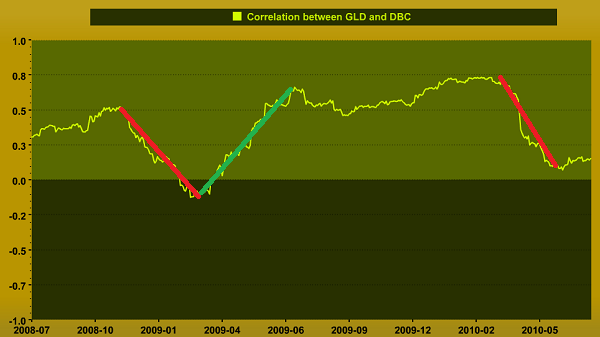
Gold sometimes rises becasue of inflation fears, and sometimes out of fears for the financial system. Steve Place concludes that gold was not pushed up by inflation demand after checking the correlation between GLD and a multi-commodity ETF (DBC). While gold was going up late last spring, the correlation between the two dropped to only slightly positive - or near-zero.
This is a correlation between two etfs: GLD and DBC.... DBC is a commodity etf that has exposure in heating oil, crude, gold, natty, zinc, and others. Basically, when GLD and DBC are highly correlated, that means there is more risk of inflation, and when the correlation breaks down, it means we are in a “risk aversion” mode.

This can actually make for a nice long term timing of the market, and we’re coming down to levels in which I feel the risk for reflation could be coming back into play (maybe). A confirmation would be a drop in demand for treasuries.

It's an interesting tool, as it's sometimes hard to see whether financial-crisis demand is tied to expectations of future inflation or not.

Poking Around For Likely Takeovers

A Morningstar report says takeovers are going to continue in the gold-mining sector, and it tries to identify some. Since the report left out gold juniors, the universe of small- and mid-tier producers it works with is fairly small.

According to its author, Joung Park, there are three factors motivating a takeover as based upon recent ones: the potential target has to have sizable amounts of low-cost reserves, near the potential acquirer's own properties, and there already has to be a joint-venture or minority-stake relationship between the latter and the former. Based upon these criteria, the only takeover candidate Park fleshed out is Kinross Gold; that company is a potential target for Barrick. Two other candidates are mentioned, but the would-be acquiers would be more likely to buy a property instead of the whole company in those cases.

Wednesday, July 28, 2010

Jeb Handwerger Sees Support For Gold At These Levels

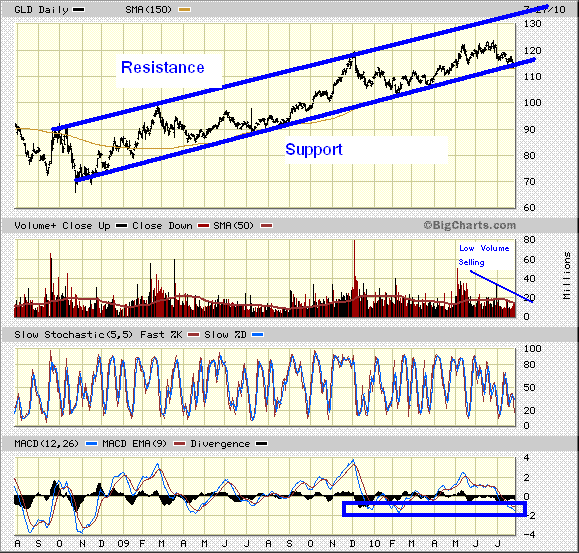
Unlike this Barclays techncial analyst, Jeb Handwerger sees gold as still in a rising channel that provides support at these levels. Consequently, he thinks gold is in buying-opportunity mode right now.
Gold is now at my buy point of the rising long term trend support line (click on chart...). GLD touched that line 6 times, which signifies that this trendline is a reliable point of support. The significance of this line is that it is not steep, which also brings a higher probability that GLD will find support here. It is also oversold. Continued weakness here and a break below this long term trend would be troubling and highly unlikely. If there is a break most likely it would be exhaustive, meaning that it will shake out a lot of shares before the next move higher. I do not see $1200 as a top in gold as there are no technical signs of a major top.
He also sagely notes that the best time to buy usually makes the buyer uncomfortable. To extend his winter-coat-in-summer analogy, it can be awkward sporting a winter coat around in the heat.

Another Gold-Watcher Says Buying Opportunity Coming

Dominic Frisby points out that times like these are shake-out times for those who are trend-chasers or who don't really believe in gold. Generally, summer is a good time to buy gold; the only exception came due to the financial crisis, but the metal recovered to its summer levels and above by the end of the year.

He uses the 252-day moving average as a touchstone. Right not, it's at $1,110; that level, he recommends, would be a real buying opportunity for the metal.
To conclude - we know that the July-August timeframe has been a good time to buy gold in recent years. Given that in the coming weeks gold looks likely to touch, or come close to touching, its 252-day moving [average], which have proved such a consistent marker over the last ten years, I'd suggest that if gold falls another $50 or so from here, that could well mark an excellent buying opportunity for those who don't currently have, or those who want to add to, a position in gold. (And, by the way, somewhere just beneath the blue line might mark a sensible place for a stop).

Of course, it's possible that the bull market is over. I don't think it is, but that doesn't mean I'm right. I see $1,040 - the old high - as a big number for gold. If it falls beneath that, then we need to have a serious rethink.

There is that risk, and he is cognizant of it; he's no superbull.

Tuesday, July 27, 2010

Walter de Wet Says Gold Looks Techncially Bearish

In the midst of a short analysis of the gold market, Standard Bank analyst Walter de Wet says gold looks technically weak:
In technical terms, gold looks bearish within a $1,181 - $1,174 range where the 100-day MA and long-term support trendlines meet. However, in the physical market, buying interest is providing support around this crucial technical range for gold. A break below this range could see gold decline to $1,150.
It's hard to criticize his timing. This morning, the metal tumbled down to $1,160 as the previous range bottom broke through.

Fall Run To $1,300?

Despite gold's present doldrums, an options advisor at www.skoptionstrading.com says the metal looks positioned to mount an assualt at $1,300 starting in a month or so. Despite that call, (s)he says it's too early to buy out-of-the-money call options on gold. Leaving open the possibility that it will fall to around $1,140, the advisor suggests selling out-of-the-money puts on the metal for now. August puts below $1,140 are being considered. Then, in late August, the next trade should be buying out-of-the-money calls, with strike price of $1,250 or higher, expiring in January '11 or later.


This strategy depends upon gold's seasonal weakness turning into a strong rally in the fall. The first half of it, selling those puts, seems the less risky play.

James Altucher's Favourite Gold Stock

Yes, he has one. Despite his aversion to gold as an investment, he likes Kingold because he thinks it has a lock on the mainland Chinese jewelry market although it's present market share is only 4.3% by his calculation. The company sells gold jewelry, and has its supply chain management fine-tuned to the point where there's an average of five days between buying the raw gold and selling the jewelry. According to Alucher, who believes in gold as a luxury good, the Chinese jewelry market is growing strong.
One of the biggest demographic trends that will be occurring over the next ten years is the rising middle class in China. The China middle class is growing by approximately 50mm people a year and represents 25% of the population now, up from less than 5% of the population a decade ago. That means, for instance, that China has gone from being the 20th country ranked by oil consumption to the 2nd country and is now number one in terms of total energy consumption. It also means the demand for luxuries by this nouveau middle class is now insatiable, growing, and cannot easily be satisfied due to lack of supply....
Altucher lists seven points in Kingold's favour, including growth of the market as well as growth of the company itself. Three of them involve strong revenue growth, strong earnings growth and a low forward P/E ratio. The company's trailing P/E is about 18 right now.

Monday, July 26, 2010

Large Commercial Net Shorts Plunge

That's what an analysis of recent Commitment of Traders reports shows to Gene Arensberg of GotGoldReport. His tracking of large net commercial short positions shows a large drop of 25.6% over the past three weeks. The last three-week period with a larger drop was in August of 2008, just before the financial crisis. Long commercial net short positions as a percentage of total open interest also dropped quite briskly in the last week.
The drop in LCNS outpaced the drop in open interest at a roughly 4:1 pace in the week ending last Tuesday. And when we see that, it suggests that the largest "paper gold" sellers are aggressively closing out their "hedging".

As gold sold down from the $1260s to the $1170s, please note that the LCNS:TO has fallen to its low of the year, and this is the first time the LCNS:TO has fallen below 39% since December 9, 2008 – back amid the post-Lehmans panic.

The fact that the LCNS:TO has fallen so far on what is essentially only a modest, roughly 7% pullback for Gold Prices suggests a major shift is underway in the futures market. We view the current LCNS:TO of 38.6% as considerably more bullish than bearish. The largest commercial traders, as a group, seem to be rushing to cover or offset their net short positioning as gold consolidates in the $1170-1210 range.

That doesn't necessarily mean that gold won't continue to sell off even more. It can and it might. But these date certainly do mean that the largest "hedgers" and short sellers of paper gold have closed out a substantial amount of their collective net short positioning on what amounts to a net $50 drop in the Gold Price, as measured on Commitment of Traders reporting Tuesdays.
The neat thing about this finding is, it works as a contrarian indicator whether or not the big commercial shorters are manipulating the market. If not, if the large net short position on Comex is hedged elsewhere, then it signifies a lull in demand that might reverse later.

Friday, July 23, 2010

Another Buy-On-The-Dip Recommendation

As summarized by Jay of "Market Folly," a MarketClub analysis using Elliot Wave tools came up with an entry zone between $1,157 and $1,132. The former is near the 50% retracement level from gold's record high, and the second is near the 61.8% level. Both are support levels.
MarketClub also points out a previous bearish divergence in the MACD as it turned negative while gold still headed higher in May and early June. That divergence provided an early signal as gold began to decline in late June. Adam thinks a divergence to the upside is about to take place and an entry point into a gold long should be coming.

Keep in mind, though, that he still feels gold will trade down/sideways in the very near-term. The buy level he is looking for is between 1,132 and 1,157, which implies some further downside. Those levels, coupled with confirming indicators, could provide an excellent entry he feels....

Again, there are lots of buyers who will have their orders triggered long before $1,157 unless there's a plummet that encourages them to pull their bids. The only way I can see the zone being entered is through such a plummet and its aftershock.

Thursday, July 22, 2010

An Interesting Pairs Trade

Gene Chan's rationale is both simple and straightforward. He suggests shorting GLD and buying SLV, making for a pairs trade that'll work out if the gold-silver ratio narrows.
[C]onsider that a geological analysis of the Earth's crust shows that silver is only 17.5 times more abundant than gold. In fact, over the last 4500 years of history the average price ratio between silver and gold is pretty close to that number. Back in the days when metals are still money, you could exchange 1 gold coin for 16 silver coins.
What this means is that gold is severely overvalued versus silver, and the gap will revert over time, regardless of whether precious metals as a group rise or fall.
He considers gold to have a fat speculative premium built in, which silver doesn't. Plus, anyone expecting economic Armageddon would find silver easier to use for ordinary transactions than gold.


There's a more conservative means to playing it this way: simply buying physical silver, perhaps along with physcial gold. The most cost-effective way fo doing so is through "junk silver" coins.

Wednesday, July 21, 2010

Jeff Clark's Riff On Buying The Dips

Jeff Clark says the summer is the best time to buy gold and gold stocks, and supplies a fair bit of seasonal analysis in several charts embedded in his article. The tendency applies to gold stocks, which show definite weakness in June and July.


Based upon his study of average pullbacks, he arrives at a buying price of $1,126.98. Interestingly, the recent price of gold - and gold after late-spring and summer routs - has been considerably above that level, corresponding to an average 8.9% decline. This year, the metal has already dropped below the indicated price of the smallest drop, $1,209.99, so this year won't be setting any records. So far, though, it's clocked in at below average decline-wise...and we're already coming up to late July.

Tuesday, July 20, 2010

Buying Opportunity?

Over at Minyanville, gold cycle analyst Toby Connor uses a multicycle analysis to conclude the gold bull market is still intact, and fears of a bubble popping in the immediate future are unfounded. He makes the noteworthy point that no secular bull market has ever come to an end before a blow-off phase, which has not occurred in gold yet.

After he works down to a daily cycle, he has this advice to offer:
...we can extrapolate a reasonable timing band for a final bottom somewhere in the next one to two weeks.

Here's what to look for:

First off, I think gold will need to retrace at least 50% of the intermediate rally. That would come in around $1,155.

Next, I'd like to see sentiment turn extremely bearish. We're already well on our way to that happening as public sentiment is now nearing the same levels we saw at the February intermediate cycle bottom.

About this time we'll see the conspiracy theorists blaming a mysterious gold cartel for what, in reality, is just a normal correction within an ongoing bull market, and one that happens like clockwork about every 20 weeks.

So the bottom line is, we're on the verge of getting one of the best buying opportunities we ever get in a bull market sometime in the next week or two. The question you have to ask yourself is, will you take it or will you let the "technicals" talk you into missing another fleeting chance to accumulate at bargain prices in the only secular bull market left? Let's face it, at intermediate cycle bottoms, the technicals aren't going to look like a bottom. Instead, they're going to look like the bull is broken.

I don't want to get into the manipulation issue, but his use of volubility as a sentiment indicator does make some sense.

I should add another point: there's not only the possibility that gold will go significantly lower than his buy point, but there's also the possibility that gold will bottom while still above it. Even with clear-cut advice, there's always a judgment call and some kind of risk.

Friday, July 16, 2010

Nick Barisheff Explains Gold Shares' Relative Underperformance

In a nutshell, the reason is gold benefits more during a crisis than gold shares. Mining companies are businesses and carry risks that gold itself doesn't. During a financial crisis, market participants become more sensitive to business risk regardless of the business. That's why gold shares plummeted in the Crash of '87 while gold itself was hardly affected; that's also why the HUI got clobbered far more than gold itself in the crisis of '08. One chart from his article shows the HUI losing all of its gains since the beginning of 2000 at the nadir of that crisis:


Given gold's long-term bull market, that was pretty tragic.

Thursday, July 15, 2010

Intriguing, If Risky, Gold Buying Technique

Dr. Steve Sjuggerud has come up with an interesting strategy to stay in gold during a long-term bull market and get out when the bear market comes. It depends upon the gold supercycle, in which a fairly steady bull market is followed by a long-drawn out bear. He calls it his "Simple Strategy," and it works like so:

Monitor gold prices in four major currencies: the U.S. dollar, the euro, the British pound, and the Japanese yen. If gold is up in terms of all four currencies in the previous month, then buy (or hold) gold. If not - if the metal is down in terms of any of these four currencies - then cash in the gold and put the proceeds in a money-market fund. Keep the funds there until gold has increased in terms of all four currencies in the previous month.

Presumably, a gold accumulator would add the new funds to the switch when the signal first flashes "buy," and would add if the latest month shows the same signal after the other funds have been invested with gold. If the signal flashes "sell", or "don't buy," the adds would go into the money-market fund.


It's an intriguing idea, despite the potential for being nickel-and-dimed to death through whipsaws that would be exacerbated by buying and selling physical gold. Gold does tend to move in long-term waves, which makes the strategy ostensibly practical. One variant would be to shift into stocks instead of gold because long-term bear markets in gold tend to accompany long-term bull markets in stocks. [1980-2001, for example.]

He claims a 14.5% return over the past forty years using this strategy, but it's the result of backfitting. He doesn't say what he used as a proxy for the Euro before it came into being.