Showing posts with label goldprice. Show all posts

Friday, August 6, 2010

Gold Tops $1,210, Slides Back To $1,205

Thanks to an encouraging (for the gold market) employment report that showed private-sector payrolls growth well below expectations, gold shot up to $1,208 by 9 AM ET and briefly touched $1,210. There was a pullback, but it wasn't that great in extent; the drop ended at $1,206. Then, gold continued to rise but in a laboured fashion. Poking above $1,210 twice before the laboured rally ended, when the metal touched $1,212.20, it fell back to a little above $1,206. A third attempt at $1,210 resulted in another poke-above that failed to hold. As of 11:56 AM, the spot price was $1,207.10 for a gain of $12.20 on the day. The Kitco Gold Index split the gain into +$5.35 for predominant buying and +$6.85 for a weakening greenback.

What got gold gaining, got the U.S. Dollar Index tumbling. From around 80.85, the Index descended to below 80.1 before the decline halted as of 10:07. From there, it recovered with a slow and rolling advance that still left it well below 80.5. As of 11:58, it was at 80.35.

Needless to say, $1,200 has been smashed. The reaction to what was really a mixed report - the unemployment rate of 9.5% was slightly below expectations - shows pent-up demand for the metal that was waiting for a catalyst. Gold may fall back later, as has often been the case after recent morning leaps, but a close above $1,200 seems assured.


Update: Gold did break through $1,206 on the downside, making for an afternoon post-leap pullback. After doing so, the metal stayed between $1,204 and that price until a little before the end of the pit session. As of the end, or 1:30 PM ET, the spot price was $1,203.40 for a gain of $8.10 on the day. The Kitco Gold Index divided the gain into +$2.15 for predominant buying and +$6.35 for greenback weakness.

The U.S. Dollar Index kept climbing in early afternoon, but slowly. Before pulling back, it barely climbed above 80.4. As of 1:30, the Index was at 80.34.

Despite the letdown gold is still well above $1,200 - and it's still likely to close above that number, making for another third-time-lucky test.


Update 2: Gold did close above $1,200; in fact, it closed above $1,205. The dip below that level at the end of the pit session continued for a short time afterwards, but then reversed with gold climbing back up to $1,206 by 2 PM ET. The rest of the electronic-trading hitch was quiet, with the metal fluctuating a little above $1,205 except for a brief reversed dip. As of the close, the spot price was $1,205.70 for a gain of $10.80 on the day. The Kitco Gold Index apportioned the overall gain into +$4.90 for the predominant-buying category and +$5.90 for the weakening-greenback one.

This week saw a reversal of the declines that previous weeks ended up displaying. Last Friday's close was at $1,181.40, so this week saw a substantial gain of $24.30 or 2.06%. The close for this week was also well above that of two weeks ago.

The U.S. Dollar Index, after managing to get up to 80.425 at 1:15, stayed between that level and 80.295 for the rest of the session except for the last five minutes. A jump above the high didn't stick, though, and the Index closed the week at 80.39.

Its daily chart, from Stockcharts.com, shows the recent attempt at basing thwarted:


Again, what I thought would be the beginning of a short-term turnaround wasn't. The Index managed to stay above the 80 support level, but its reaction to this morning's jobs report shows bearish sentiment has not been exhausted. The Index's RSI level, found at the top of its chart, is still in oversold territory.

It's gone so low, a pattern is beginning to show up - one that does not bode well for it. The Index is very close to touching the same level it was at on April 14th and 15th, before the Eurocrisis-fueled rally got rolling. All but a smidgen of the rise subsequent to those mid-April days, right up to above 88.5, has now been erased. The Index started a late March rise, which took it up to above 82.25, at a little above 79. The descent to 80 comes close to making a head of a months-long head and shoulders reversal. There isn't really a neckline, but more of a neck zone between 79 and 80. The Index only has to fall a little further before entering that zone - and it may.

All it would take to complete that pattern would be a future rise to well below 88 and a fall below 79. Since the pattern's been long in developing, it would take some time to see whether it will go to completion.

Turning to gold, its own daily chart shows its breakthrough above $1,200:


The crossover of gold's MACD lines, found at the bottom of its chart, had the say. Two days after switching to a bullish configuration, the metal has advanced beyond an important resistance level after two days of trying. The third time was the charm.

The metal's RSI level is comfortably above the 50 neutral level, a zone at which it's not been at since the end of June when it was around $1,240. The inverse head and shoulders bottom I was expecting didn't come to pass because gold continued rallying above what would have been the neckline of it. Technically, gold is looking pretty good.

Certainly, it looks better than it did as of last Tuesday's close. Then was the cut-off for this week's Commitment of Traders data, as graphed here. At that time, though, gold had finished the fifth day of its six-day rally; so, the technicals looked fairly good then. As of that time, total open interest had shrunk for the fifth week in a row. All reportable categories shrunk, including the well-watched commercial shorts category. The category that shrunk the most in percentage terms was commercial longs, which decreased by 7.00%. The least, non-commercial longs by 2.43%. Interestingly, long was the place to be for the rest of the week; the latter category, as a category, showed the least disconnect from what transpired later in the week.

As for the U.S. Dollar Index's own CoT data, graphed here, its total open interest remained low but managed to barely break the recent losing streak. Commercial longs nearly doubled from their recent sliver. The only other category to increase was non-commercial shorts, by 28.9%. The other two categories declined. Given the Index's brief rebound the following day was more than checked by two subsequent down days, the non-commercial shorts had it.

A post-pit Reuters report says gold was up on safe-haven demand triggered by the disappointing nonfarm payrolls component of the jobs report. Amongst the points therein, these were included:
* Gold accelerated gains and Wall Street sank after government data showed U.S. private employers added fewer workers to their payrolls in July than expected.

* Recent weak economic data suggested interest rate will be low for a while, which is very good for the precious metals relative to other assets - Thomas Winmill, portfolio manager of Midas Fund MIDSX.O.

* The usual inverse relationship between gold and the dollar has shown signs of a resurgence, after the link loosened earlier this year as extreme risk aversion benefited both assets - analysts.
Gold definitely has had the better of the now-inverse corrlation lately. If things go well, the metal will stay above $1,200 next week and build a base at the new higher level. It's past the bargain-hunting zone, but new demand is beginning to show up. August is starting to shape up as the month when gold shakes off those summer doldrums.

In closing, thanks for stopping by and reading what I've posted here. May your weekend be unmuggy.

Gold Stays Steady In 1190s

There was some fluctuation in gold during the overnight session, but the overall direction was sideways; roughly, the metal centered around $1,195. Signs of a slowdown in Euroland emerged with U.K. factory output rising by a less-than-expected 0.3% and German industrial production unexpectedly falling by 0.6% in June. Gold initially fell last night, bottoning below $1,193 a little after 8:00 PM ET, but then rose. Peaking at $1,199.60 as of 4 AM, the metal slid down once again to bottom at $1,192.50 more than two hours later. Turning around, its subsequent rise was muted but enough to carry the metal above $1,194. As of 8:02 AM, the spot price was $1,195.00 for a gain of $0.10 on the day. The Kitco Gold Index attributed +$1.30 to predominant buying and -$1.20 to strengthening of the greenback.

The U.S. Dollar Index stayed mostly flat last night, but rose starting at 3:40 AM after a slight fall to 80.7. Reaching almost 80.95, the Index double-topped and then pulled back a bit. As of 8:08, it was at 80.87.

A Wall Street Journal article says gold has remained flat on low volume due to anticipation of an especially good or bad unemployment number.
"There is a lack of liquidity and everyone is just waiting to see how the data looks," a trader said. "A strong number either way could really move the market."

Expectations of more robust data, following some increasingly positive figures out of the U.S., have been reduced somewhat after Thursday's disappointing U.S. jobless claims data, SEB analyst Bjarne Schieldrop said.
Generally, the weaker the numbers the better for gold. Although not mentioned in the report, holdings of the SPDR Gold Shares Trust increased 0.92 tonnes yesterday to 1,282.75 tonnes.

The U.S. jobs number came out, and the unemployment rate shows a slightly better picture than was expected; the overall picture was mixed. July's rate of 9.5% was slightly better than expectations for 9.6%, but private nonfarm payrolls expanded by 71,000; expectations were gfor a gain of 100,000. The total number of jobs lost was 131,000. The gold market took off on the news. Starting at $1,196, the metal shot up above $1,200 to reach $1,208 before stalling. As of 9:02 AM the spot price was $1,207.40 for a gain of $12.50 on the day. The Kitco Gold Index split the gain into +$6.30 due to predominant buying and +$6.20 due to weakening of the greenback. The U.S. Dollar Index, as indicated, reacted badly to the news. From about 80.85, the Index fell all the way down to 80.35 before stalling. As of 9:05, it was at 80.38.

$1,200 has been tested, and gold has shot through. The gain's been strong enough to give a good chance for the metal closing above that level today.

Thursday, August 5, 2010

After Touching $1,200, Gold Slumps Back

Gold managed to touch $1,200 in the beginning of regular trading on the heels of a disappointing jobless-claims report, but its momentum faded at 8:50 AM ET. From then until just after 11:00, the metal rolled downwards to a new daily low of $1,189.20. A relief rally took it to $1,194 shortly afterwards, but the momentum of the last six days has been broken. As of 11:55 AM, the spot price was $1,194.20 for a loss of $1.40 on the day. The Kitco Gold Index attributed -$1.70 to predominant selling and +$0.30 to overall weakening in the greenback.

The U.S. Dollar Index, after being knocked down by the jobless-claims report, recovered in mid-morning. At the same time gold reached its low, the Index almost touched 81.0. Since 11:07, it's been hovering just below that level. As of 11:57, it was at 80.91.

The newly-restored inverse correlation between gold and the greenback has asserted itself to the detriment of the metal. There may be somewhat of a pickup in the afternoon, but it looks like gold's recent momentum will stay drained.


Update: The momentum did come back, enough to put gold into the gains column. The recovery rally that began a little after 11 AM ET continued through 12:45, when the metal managed to get a little above $1,197. $1,200 eluded it, though. After that peak, it sunk down to around $1,195 and hovered between there and $1,196 before pulling up. At the end of the pit session, or 1:30 PM, the spot price stood at $1,197.30 for a gain of $1.70 on the day. The Kitco Gold Index split the gain into +$0.35 for predominant buying and +$1.35 for greenback weakness.

The U.S. Dollar Index continued to hold below 81.0, and lost a little ground in early afternoon. It managed to stay above 80.85, but bumped against that lower level. As of 1:30, the Index was at 80.86.

As for gold, its recovery from its morning drop shows an overall stall between $1,200 and $1,190. $1,200 was not tested again after that post-jobs-claims rally. Although held back, the metal is still showing some price resilience. There's a good chance of a slight gain at the close.


Update 2: That chance wasn't met, even though the end-of-pit rally got gold up to $1,198 by 1:50 PM ET. For the rest of the afternoon, the metal slowly trended downwards or sideways with nary a relief rally. At the end of regular trading, the spot price was $1,194.90 for a slight loss of $0.70 on the day. The Kitco Gold Index assigned -$3.70's worth of change to the predominant-selling category and +$3.00's worth to the weakening-greenback one. Both categories sum up to the raw change on the day.

The U.S. Dollar Index ended up falling below 80.85, which helped catalyze gold's final rally in regular trading. The Index then trended downwards, but not by much; it ended up fluctuating around 80.75. During that time, gold followed its own path downwards. As of 5:30 PM, the Index was at 80.77.

Its daily chart, from Stockcharts.com, shows its holding pattern continuing:


Today's interday high was slightly higher than yesterday's, which itself was higher than that of two days ago. The daily lows of all three days were about the same. Still, the Index was down from opening to closing.

Its 200-day moving average, as shown by the red line in the lower middle of its chart, has continued to provide support. The Index's RSI level, found at the top, is still in oversold territory. There hasn't been any real springback as yet, but the Index may be preparing for a secondary run-up.

As for gold, its own daily chart shows its rally stalled:


This morning's test of $1,200 is evident from the chart, but so is the lower interday high as compared with yesterday's. The $1,200 barrier has proven to be fairly potent, especially since there's been no real sustained driver for gold except bargain hunting that melts away when the price approaches that barrier.

Perhaps there won't be any sustained rise unless there are signs of inflation in the developed economies kicking in. More immediately, the Fed undertaking a second quantitative-easing program would provide the necessary kicker. Gold may well stay stuck in the 1,190s for the nonce, and there's the possibility of it falling to the 1180s. In the latter zone, bargain hunting will come back.

A post-pit Reuters report, which preceded the electronic-trading-hitch slump, said gold rose for the seventh day in a row because of a weaker greenback and a leap in grain prices. Amongst the points therein, these were included:
* Weakening of the dollar beginning to work in favor of gold recently - James Steel at HSBC.

* Rising wheat prices after Russia said it would temporarily halt grain exports due to the country's worst drought on record sparked inflation worries - Steel said.

* On charts, a buy signal was triggered earlier this week when the MACD moved above the signal lines, according to the moving average convergence/divergence (MACD) analysis.
That crossover took place yesterday, and evidently made an impression.

In and of itself, the bump-up in wheat prices is a temporary spike but it may catalyze a big run in the commodity. Gold's reaction to it suggests players are on the lookout for inflation, putting the doubt to the recent deflation talk. The metal may be due for a rest tomorrow, but it's still in a fairly good position technically. A drop below $1,190 is unlikely.

Gold Drifts Around $1,195

There wasn't much action on the gold market overnight; the metal drifted around $1,195 for the entire session. Both the Bank of England and the European Central Bank left their respective rates unchanged, the former at 0.5% and the latter at 1%. Both announcements didn't change gold all that much, although the metal was creeping up earlier. As of 8:06 AM ET, though, the metal perked up to make the spot price reach $1,197.30 for a gain of $2.10 on the day. The Kitco Gold Index attributed -$0.80 to predominant selling and +$2.90 to weakening of the greenback.

The U.S. Dollar Index basically stayed where it was last night, hovering just below 81. A break above that level around 2:30 AM prefaced a peak above 81.1, which reversed at 3:25. The resultant slide took it down to 80.6 before a relief rally kicked in starting at 7:10. As of 8:13, the Index was at 80.79.

A Bloomberg report says gold stalled because of concern that the rally has engendered less physical buying.
“We are seeing resurgent interest from the investor community,” said Andrey Kryuchenkov, an analyst at VTB Capital in London. Still, “interest from Asian buyers is likely to ease in the very short term, as prices have significantly recovered from July’s lows.”...

“Gold may take a breather before continuing on its longer- term trend, underpinned by strong demand from India and China,” said Ong Yi Ling, an analyst with Phillip Futures Pte.
The article also mentions holdings of the SPDR Gold Shares Trust declined by 0.45 tonnes yesterday to 1,281.83 tonnes.

A Reuters report says gold was held up by fund buying and Asian consumer demand.
Much of gold's safe haven appeal for investors that derived from the euro zone debt crisis and pushed prices to record highs in late June has evaporated.

But James Moore, an analyst with thebulliondesk.com said renewed confidence in the global economy, helped by upbeat corporate earnings, has lifted the broader commodity complex as well as gold itself by association.

"While we have seen a bit of improvement in the European debt situation, I think investors are still very cautious and obviously, more and more people are looking to diversify their portfolios. So, even if they only add a fraction of gold, those numbers add up," Moore said.
The article also cites Edel Tully as noting the 30-day correlation between gold and the greenback has turned negative.

A Wall Street Journal report says gold is holding steady because of uncertainty over U.S. jobs data.
Better-than-expected jobs data Friday could rejuvenate investors' appetite for growth assets and dim demand for safe havens like gold.

"We have to wait for the payroll figures," said Narayan Gopalakrishnan, a trader at Swiss trading house MKS Finance in Geneva. "Overall it's range trading [until then]."

A return to the lows of July, however, is unlikely, analysts said. Physical demand from the jewelry sector has been solid, providing a floor for prices.

The weekly U.S. jobless-claims number was released at 8:30; it showed a rise in first-time claims to 479,000 when a fall to 453,000 was expected. Regular trading opened with a rise in gold, which continued when the figure was released. Despite the hype over the figure, gold didn't make $1,200 afterwards. As of 8:52 AM, the spot price was $1,199.60 for a gain of $4.00 on the day. The Kitco Gold Index assigned -$1.60's worth of change to predominant selling and +$5.60's worth to greenback weakness. The U.S. Dollar Index reacted to the release with a slump to below 80.55 before another relief rally set in. As of 8:55, it was at 80.63.

So far, gold is on track for a seventh daily gain albeit a slight one. $1,200 remains intractable, although the metal is still veering up against it. A more sustained test of that level may be in the offing today.

Wednesday, August 4, 2010

Gold Pokes Above $1,200, Then Chokes

After being barely fazed by the ADP data report showing stronger job growth than expected, gold entered into a staggered rally that took it up above $1,200. The actual break came at about 8:50 AM ET, but it stuck until a pullback more than an hour later. The peak of the rally made for a new daily high of $1,204.20. The metal sunk to below $1,200 again on the heels of an ISM report saying the U.S. service sector in July expanded slightly but more than was expected. Again, the good news proved to be bad news for gold; the resultant pullback was a little more than a momentary interruption. Another rally, starting at 10:20, peaked at less than the first one but well above $1,200; a later pullback, though, left gold a little lower than that level. As of 11:58, the spot price was $1,198.90 for a gain of $13.30 on the day. The Kitco Gold Index attributed +$18.30 to predominant buying and -$5.00 to a strenthening greenback.

The U.S. Dollar Index did strengthen in mid-morning due to that ISM report after drawing a little strength from the ADP one. It got started just before 10:00, but got on a roll afterwards; the rally didn't stop until the Index brushed against 81.1. 81 didn't hold, but the Index descended to a level not far below; as of 11:59, it was at 80.97.

The rally in the greenback did dampen gold's increase, as the metal's high of the day was made before the Index's run. Given the resistance met at $1,200, gold closing above that level isn't very likely. Still, the gain has been fairly impressive. There might be another test of $1,200 in the rest of the pit session.


Update: There was, but the test led to a downturn that took the metal below $1,195. Starting around 1:00 PM ET, it descended from right around $1,200 all the way down to $1,194. No news accompanied that breakdown, which seems to be the result of the earlier greenback rally. As of the end of the pit session, or 1:30 PM, the spot price was $1,193.70 for a gain of $8.10 on the day. The Kitco Gold Index assigned +$14.80's worth of change to predominant buying and -$6.70's worth to greenback strength.

The U.S. Dollar Index, after hovering around 80.95, managed to climb back above 81 just after 1:00. Although not making it to 81.1, it came close. As of 1:35, the Index was at 81.03.

The spill in the last half hour of the pit session put an end to any hope for gold closing above $1,200. Still, a gain of the day seems assured and there's still an outside change of the metal closing with a double-digit gain.


Update 2: That outside chance was made, thanks to a rebound near the end of the day, but just barely. The rebound that did so was the second in today's electronic-trading hitch. The first kicked in right after the pit session ended, pulling the metal up to $1,196-97; it snuck above that zone as the rise continued. Came 3:15 PM ET, and the rise turned into a decline that took gold down to $1,193 by 4:00. The second rise ended with a last-minute kicker that put the closing figure at $1,195.60, for a gain of exactly $10.00 on the day. The Kitco Gold Index attributed +$15.30 to the predominant-buying category and -$5.30 to the strengthening-greenback one. Those two categories sum up to the raw change on the day.

The U.S. Dollar Index, after hovering around 81.1, slid down for more than an hour after 2 PM. Getting below 80.9, it stayed around that level before regaining most of the loss; despite that rebound, it failed to make 81 again. As of 5:30, the Index was at 80.935.

Its daily chart, from Stockcharts.com, shows the first up day in six:


Unlike the previous up day, this one wasn't that insubstantial. Today's close was at the same level as yesterday's open, so today's action reversed yesterday's. The Index's RSI level, found on the top of its chart, is still in sub-30 oversold position but less so than yesterday. As it turned out, touching the 200-day moving average yesterday did act as a kind of support (at least for now.)

It's been quite the downward slide, so some kind of rebound was inevitable. The last upturn only lasted a day; the one before last, four. That earlier one, starting July 19th, was good for a point and a half between bottom and top. I can't say how long this one will last, only that the low RSI level indicates the Index is due.

As for gold, its own rise today made for the sixth gain day in a row:


Its poke above $1,200 shows in the top of today's candlestick. Gold's own RSI level is slightly above neutral, a level that's associated with short-term tops ever since the beginning of July. Even if the metal pulls back from here, its current run has been large enough in extent to make for a head in an inverse head and shoulders reversal. With a neckline around $1,205, the pattern indicates a durable rise into the 1200s if completed. So, even if gold sinks back into the 1180s, the technical position isn't that bad anymore.

Moreover, the MACD lines at the bottom of the chart have shifted to a bullish configuration for the first time since June. This switchover does not guarantee the rally will continue tomorrow, but it does indicate that gold's doldrums have come to an end.

A post-pit Wall Street Journal report says an increase in mainland Chinese demand, plus speculation that the Fed will undertake more quantitative easing, pushed gold up today.
Gold was supported Wednesday by speculation that the Federal Reserve may lower interest rates or buy bonds to try to boost the economy, said Tom Pawlicki, precious-metals analyst with MF Global in Chicago. Even symbolic action by the Fed could send a signal that officials believe the economy is at risk of deflation or a renewed slowdown, enhancing the appeal of gold as an alternative asset....

Futures also received continued support Wednesday from the news that China would take steps to expand its domestic gold market. The People's Bank of China Tuesday announced that the government would permit more banks to export and import gold. Analysts say the easing of restrictions shouldn't immediately lead to an increase in gold investment, but it represents an expansion that could make China a larger player in the international gold market.

"I think the Chinese news is a longer-term underlying theme," said Adam Klopfenstein, senior market strategist with Chicago-based Lind-Waldock. "If they're going to get more aggressive in letting people buy and sell more gold, it's a precursor to more moves from the central bank" in the gold market.

The metal may pull back (further) tomorrow, but the extent of the rise so far has put it in a good position for the coming month. Another gain might as well be a bonus.

Gold Breaks Above $1,190

There was little accompanying news in this cycle, but gold managed to break above the barrier that's stymied it for the last two days. The metal bumped up against $1,190 for a two-hour stretch starting just after 7 PM ET. The breakthrough came around 9:00, and the metal ascended to $1,193-4. Falling back to slightly below $1,190 by 2 AM, the metal reversed course and rose to the $1,195 level and later beyond. As of 7:59 AM, the spot price was $1,196.40 for a gain of $11.40 on the day. The Kitco Gold Index split the gain into +$10.50 for predominant buying and +$0.90 for weakening of the greenback.

The U.S. Dollar Index actually rallied through most of the overnight session, but shed its gains in early morning. Although jaggedly, with an interrupting spill that erased all of its gains, the Index managed to climb up all the way to almost 80.8 by 4:35. The reversal was also jagged, with a sharp drop followed by a sharp recovery that took the Index back to 80.75, but was enough to take it well below 80.55 before reversing too. As of 8:11, the Index was at 80.59.

A Reuters report said gold rose as a result of the PRC's liberalization of the mainland Chinese gold market and a current damping of the appetite for riskier assets, and was held back by lack of safe-haven demand.
"The initial impetus of safe-haven buying of gold has faded away," said Standard Chartered analyst Daniel Smith. "We are slowly moving to other drivers."

"Ultimately we are going to see more portfolio money coming into gold," he added. "We could see consolidation in the short term, but ultimately on a one to three month view we are going higher."...

The gold market also continued to take support from news that China had taken steps to liberalize its gold trade.

"The international gold market is now paying a lot more attention to China's gold demand, not just from an official reserve asset perspective, but also private demand," UBS analyst Edel Tully wrote in a note.

"Behind India, China is the second-largest physical consumer," she added. "Therefore any step to integrate, liberalize, and expand this market should, in time, foster a rising appetite for gold."
The article also mentions another bullish factor: rising speculation that the Fed will undertake another quantitative-easing program.

A Wall Street Journal article also pointed to the PRC liberalization.
"China became the focus of the gold market and the potential for increased demand from this region prompted gold to trade to a high of $1,194 a troy ounce in Asia overnight," said UBS analyst Edel Tully.
Also mentioned is the results of a UBS tally of twelve gold ETFs, which showed a rise for the first time since July 27th.

The ADP jobs data noted a gain of 42,000 in July for the sixth consecutive monthly gain. Although the number was well above expectations for +23,000, the gains still show no acceleration. The news bobbled the gold market temporarily, chipping its price to $1,195, but the metal recovered afterwards. As of 8:49 AM, the spot price was $1,197.60 for a gain of $12.00 on the day. The Kitco Gold Index attributed +$13.10 to predominant buying and -$1.10 to a strengthening greenback. Unlike gold, which was little affected overall, the U.S. Dollar Index got a boost from the news. Initially rallying to 80.66, it pulled back to 80.6 but rose further before pulling back to a higher level. As of 8:52, it was at 80.67.

With gold well above $1,190, and even above $1,195, the level to watch for now is $1,200. The metal is unlikely to make it above that round number, but it's now close to a test. It may poke at $1,200 later today.

Tuesday, August 3, 2010

Gold Fluctuates In Mid-High 1180s In Morning, Tests $1,190

Regular trading opened with a drop that got the price down to $1,184, but bounced back shortly afterwards. The personal income and spending data for U.S. consumers had little effect on the price, which sunk to around $1,185 between 9:15 and 9:45 AM ET. Then, the metal rallied to a smidgen below $1,190. That rise didn't last, and gold sunk back down to the $1,185 level. U.S. factory orders data for June, which showed a drop of 1.2% for capital equipment, added to the downward pressure on equity markets as well as gold.

After bottoming around 10:40, the metal reversed course and rallied all the way up to a new daily high of $1,191.90. The pullback left the metal above $1,188, suggesting further strength. As of 11:54 AM, the spot price was $1,188.80 for a gain of $6.80 on the day. The Kitco Gold Index split the gain into +$3.00 for predominant buying and +$3.80 for greenback weakness.

The U.S. Dollar Index showed a bit of strength in early-mid morning, but couldn't get much above 80.8 before it turned down again. As of 11:57, it was stuck at 80.60.

Gold has tested $1,190 gain today, but so far has not seriously breached that level. It may do so this afternoon, but a continuation in the high 1180s looks more likely.


Update: After that break above $1,190, the metal did sink back into the high 1180s. At the nadir of the pullback, it was only a little above $1,185. It bounced back somewhat but stayed in the lower end of the upper 1180s. As of the end of the pit session, or 1:30, the spot price was $1,185.40 for a gain of $3.40 on the day. The Kitco Gold Index attributed -$0.40 to predominant selling and +$3.80 for greenback weakness.

The U.S. Dollar Index stayed largely where it was in early afternoon. A slight upwards bias didn't get it above 80.65. As of 1:30, it was 80.62.

So far, gold has stayed in the higher 1180s and shows no sign of advancing much from there. Although it may bend $1,185 to the downside, it will likely rack up a gain for the day.


Update 2: Gold did manage to close with a gain, and most of the volatility in the electronic-trading hitch was upwards before retracements. Gold got as high as $1,188 before falling back, and dipped as low as $1,185 after that peak. The subsequent recovery wasn't much in extent. As of the close, the spot price was $1,185.60 for a gain of $3.60 on the day. The Kitco Gold Index assigned -$0.80's worth of change to predominant selling and +$4.40's worth to a weakening greenback.

The U.S. Dollar Index's slight upwards bias faded in mid-afternoon, but the pullback wasn't that much in extent. Except for a brief period in late afternoon, the Index stayed above 80.55; after that brief period, it rebounded. As of 5:30, the Index was at 80.61.

Its daily chart, from Stockcharts.com, shows its latest decline continuing to a rather significant spot:


Significant to a technical analyst, anyway. The Index has touched its 200-day moving average, drawn in red in the middle of the graph. That average is way below the 50-day, drawn in blue, so the Index is still far away from a "death cross." Nevertheless, the distance is also testament to how far the deterioration has progressed. The Index's RSI level keeps getting deeper into oversold territory, with little effect on its declining as yet. Today's session marks the fifth down day in a row.

There's no indication that the current downtrend will reverse by any significant margin. The 200-day moving average is widely seen as a support level amongst techncial analysts, so some technical buying may be encouraged by today's descent - even if a plain chart reading shows a lot of risk in doing so. The Index can't fall forever, so eventually it'll reverse, but the last two short-term drops almost makes it look as if it could drop forever. As with yesterday's there's no sign of any upward reversal in the offing.

As for gold, its own daily chart shows the opposite streak:


Today's slight gain makes it the fifth up day in a row for the metal. Gold managed to get, and stay, above $1,180 today. That puts it back in the range it was in before July 27th's plummet.

Gold's own RSI value is close to the 50 neutral level at which that indicator has topped in the metal's summer doldrum stretch. Down below, at the bottom of its chart, gold's MACD lines are very close to a bullish crossover. Should gold hold above $1,180, it will be a good sign of some sort of recovery settling in.

A post-pit Reuters report says physical buying has helped gold's technical position improve.
Scott Meyers, senior analyst at New York-based Pioneer Futures Inc, said that gold's direction hinged on the stock
market's performance, as a possible equities sell-off could spark higher gold prices.

He said an improved technical picture should also lift prices, after the metal tried and fail last week to break below a rising trendline in place for two years.

"There was a three-day bottom formed at $1,160 last week, and the market held there well. From a short-term technical perspective, it is indicative of a market that does perform well and will possibly advance to another level" above $1,200 an ounce, Meyers said.

If so, then gold is on the track to a better autumn. It still has some headway before reaching $1,200, as seen in its recent difficulty with the $1,190 level, but the technical picture is brightening. Maybe tomorrow will be three-time-lucky for $1,190.

Gold Inches Up, Stays Below $1,190

After an initial dip to slightly below $1,180, gold picked up last night but kept below $1,185. The metal stayed between those two values except for blips until 6 AM ET. Although breaking through $1,185, the metal stalled in the high 1180s after touching $1,190.20. As of 7:58 AM ET, the spot price was $1,185.90 for a gain of $3.90 on the day. The Kitco Gold Index attributed -$0.20 to predominant selling and +$4.10 to weakening of the greenback.

As the Euro continues its run upwards, the U.S. Dollar Index is still under pressure. After hovering around 80.95 last night, it made a run up to 81 which reversed around 2:25 AM. Dropping farily rapidly, its decline leveled off for an hour and a half before continuing more slowly; by 6:10, it was below 80.5. After a slight recovery, the Index found itself above 80.6. As of 8:07, it was at 80.63.

A Reuters report ascribed gold's rise in thin trading to a weaker U.S. dollar, plus expectations of Indian jewelers stocking up for festival season.
"I would look at the upside for gold being capped," said Ong Yi Ling, an investment analyst at Phillip Futures in Singapore, who pegged key support at a three-month low of around $1,150.

"And hence, we might actually see gold edging down a little bit if the economic data come in better than anticipated, like the consumer spending and personal income figures."....

"The market is quiet today with light buying interest from investment. But we did see some buying from India as it builds up stocks for the festival," said a physical dealer in Singapore.
The article also notes holdings of the SPDR Gold Shares Trust remained unchanged yesterday.

A more recent Wall Street Journal report also pointed to the weaker greenback.
"It looks like gold is starting to receive support from a weaker dollar and is on its way to re-establish a more normal negative correlation with the [dollar]," SEB analyst Bjarne Schieldrop said....

"Gold has once again started decoupling from the U.S. dollar," said VTB Capital analyst Andrey Kryuchenkov. "Gold's rolling monthly correlation to the U.S. currency fell to around 68% from highs above 85% last month. So, given a further improvement in risk sentiment from here, the correlation is set to weaken even more with gold prices tracking firmer PGMs [platinum group metals]."
The article also cites Edel Tully disclosing that UBS gold sales in India yesterday were the second-highest for any day this year.

U.S. disposable-income and consumer-spending numbers for June came in, and the 0.2% rise in the former and 0.1% rise in the latter [flat after inflation's factored in] matched expectations. The only effect it had on gold was to push the metal down a couple of dollars, which were tacked back on shortly afterwards. As of 8:51 AM, the spot price was $1,186.80 for a gain of $4.80 on the day. The Kitco Gold Index split the gain into +$0.10 for predominant buying and +$4.70 for a weakening greenback. The U.S. Dollar Index slumped back to 80.49, with an earlier decline helped along by the income and spending data. As of 8:54, it had mostly recovered to make 80.58.

So far, gold hasn't moved much. The upside may indeed be capped, as Ong Yi Ling said, but the downside seems capped as well. Although it's too early to say an all-out recovery is in place for the metal, it's looking fairly good as compared to late last month. Gold today might test $1,190, as it did yesterday.

Monday, August 2, 2010

Gold Touches $1,190, Falls Back

Regular trading didn't start off with much excitement, but gold got rolling around 8:30 AM ET. In the next forty-five minutes, the metal rallied from $1,176 to more than $1,190. Pulling back to $1,186, the metal rallied again. The ISM manufacturing index number appeared in the middle fo the second rally, and gold seemed to take heart from its above-consensus level. Although dropping to 55.5%, it was still above expectations for 55.0%. Gold peaked at $1,191.60 twenty minutes after the ISM release. The metal then fell back to $1,184, and fell further after dawdling at that level. As of 11:52, the spot price was exactly $1,180.00 for a drop of $1.40 since Friday's close. The Kitco Gold Index attributed -$12.20 to predominant selling and +$10.80 to weakening of the greenback.

The U.S. Dollar Index declined through most of the regular morning session, breaking and staying below 81 in the process. The decline wasn't that fast, except for a fall around 9:45 AM, but it was fairly steady until about 11:30. As of 11:56, the Index was at 80.88.

A falling greenback had helped gold a fair bit, but that advantage was erased by the mid-late morning decline. Increase in risk appetite had something to do with the retreat, as the stock market pulled and stayed up. Gold might pull back to a gain in the afternoon, but such an outcome looks iffy at afternoon's threshold.


Update: After bottoming at $1,180, the metal did recover somewhat. The recovery kicked in around 12:30 PM ET, after more than a half an hour spent near $1,180. Stalling initially, the metal climbed up to a gain as it settled in around $1,184 before inching back. As of the end of the pit session, or 1:30, the spot price was $1,182.70 for a gain of $1.70 on the day. The Kitco Gold Index assigned -$8.30's worth of change to predominant selling and +$10.00's worth to greenback weakness.

The U.S. Dollar Index, after hitting bottom of 80.775 as of 11:35, slowly climbed up before trending sideways at just above 80.9. As of 1:30, it was at 80.92.

$1,190 looks out of sight now that the pit session is over. The metal may continue to hang on to a gain during the electronic-trading hitch, but it won't be much of one.


Update 2: It did clock in a gain, and not much of one. Except for a brief dip, the electronic-trading hitch saw the metal drift between $1,182 and $1,183.50; the close came right at the bottom of the zone. As of the end of regular trading, the spot price was right on $1,182.00 for a gain of $0.60 on the day. The Kitco Gold Index (KGX) attributed -$9.70 to the predominant-selling category and and +$10.30 to the weakening-greenback one. Both categories sum up to the raw change on the day.

The KGX, ex-greenback, has gone through an all-out correction since it hit its high on June 7th. As this 6-month chart of it shows, the drop has been all the way from 1100 to a little more than 950 for a drop of about 13.5%:


Had it not been for the greenback's own drop, the current summer pullback would have been an all-out correction in US$ terms. Gold has dropped more than 14% from its record high in Euro terms.

The U.S. Dollar Index hardly moved during the rest of regular trading. The center line of a little more than 80.9 lowered a little as mid-afternoon turned into late. As of 5:30 PM, the Index was at 80.88.

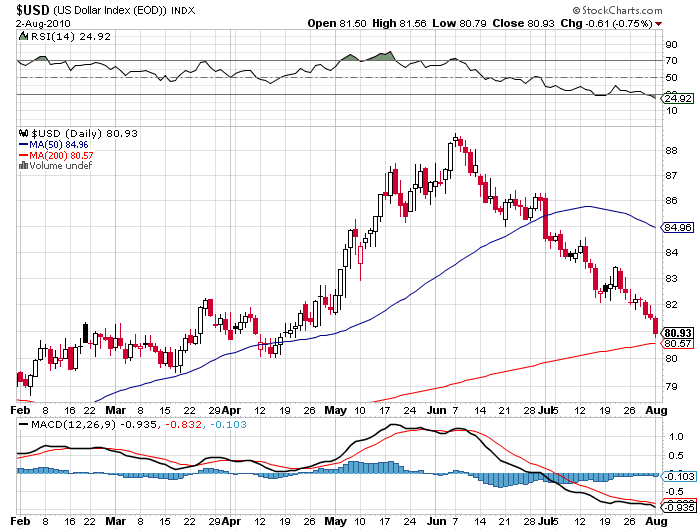
Its daily chart, from Stockcharts.com, shows its continued drop as another support level was tested:


The Euro has broken well above $1.30 and its upwards run is continuing relatively unimpeded. That was the main impetus behind the testing of the 81 support level and close slightly below it. As is evident from the chart, my belief that the Index was basing around 82 proved to be wrong. From the high of almost two weeks ago, the Index has lost about two and a half points. That's about the same amount of loss as was made in the last short-term downturn, although this one took longer. The Index's RSI level, found at the top of its chart, is well below the oversold threshold of 30.

Again, the parallels between the last two months and May of '09 are fairly evident:


The earlier period is near the left of the graph. The intermediate-term decline taking place right now has been more stretched out, and the oscillations in both indicators on the top and bottom of the chart have been more volatile this time, but the same sharp drop is evident. Should the parallel continue, the Index will jump up a couple of points or so but soften afterwards.

As for gold, its own daily chart shows a fourth day of gains - but just barely:


Gold's own RSI has been fluctuating between the high 30s and the 50 neutral level, befitting a time when the metal has softened. Despite gold still being well below $1,200, and the risk of an outright decline for tomorrow, the metal has fared better in relative terms than it has in the last two post-tumble days. The doldrums for the metal may be coming to an end.

A post-pit Reuters report says gold's rally was dampened by reduced safe-haven demand due to the U.S. equities rally. Amongst the points made therein, these were included:
* Selling by short-term traders more than offset underlying
physical demand in earlier trade - Michael Daly at futures broker PFGBest.

* Lack of trading interest ahead of Friday's July nonfarm payroll data - Daly.

* Gold has traced out a new downward trendline on charts, and a new technical buy signal will be triggered if gold breaks out the upper part of the trend.
As its chart shows, it's close to breaking that downward channel but there's still a little way to go. There is some chance that the metal will decline tomorrow as the four-day rally looks like it's running out of steam. Gold is also less of a bargain that it was almost a week ago, which will tend to hamper physical buying. The metal is still holding up, though, and it might be basing. If tomorrow's action shows a rally, there's some reason to think the weak seasonality is coming to an end.

Gold Slumps Below $1,180

Gold started the week fluctuating around last Friday's close; it started to inch up after dipping around 8:30 PM ET. Climbing all the way up to $1,185.10, reached around 2 AM, the metal began sliding back down to the low 1180s until 5:00. Then, it sunk as the Eurozone PMI clicked in with higher than expected growth for July. Not stopping until it reached $1,177 at 6:00, the metal meandered around that level before dipping a little further. As of 8:08 AM, the spot price was $1,175.70 for a drop of $5.70 since Friday's close. The Kitco Gold Index attributed -$8.50 to predominant selling and +$2.80 to a weakening greenback.

The U.S. Dollar Index slumped below 81.5 at the start of this week's trading. Pulling up to 81.55, it sunk back to around 81.4 before fluctuating between that level and 81.5. Sinking choppily from 3:25 AM, it bottomed at slightly below 81.35. As of 8:12, it was at 81.39.

A Bloomberg report, written before the drop, said gold was little changed.
“It seems to be bargain-hunting after price declines,” said David Thurtell, an analyst at Citigroup Inc. in London....

“Safe-haven buying seems to have faded for now,” Dan Smith, an analyst at Standard Chartered Plc in London, wrote in a report dated July 30.

Gains for spot gold may be capped around $1,190 an ounce, the 20-day moving average, Thurtell said.
The report also noted holdings of the SPDR Gold Shares Trust were unchanged on Friday.

An earlier Reuters report said gold was supported by physical buying in Asia and a weakening greenback.
Investment demand remained lacklustre, analysts said....

From a technical perspective, gold's price decline in July leaves it vulnerable to further losses, analysts said.

"The weekly trend remains bearish as we have now seen the third consecutive down week, and two consecutive weeks with lower intraday highs and lows," ScotiaMocatta said in a note.
The article also mentioned a lack of safe-haven buying due to increasing risk appetite.

A more current Wall Street Journal report says gold has been stable overall.
Friday's GDP data suggested there is still enough uncertainty regarding the speed of the economic recovery to support demand for gold as a perceived safe haven, market participants said.

But UBS analyst Edel Tully noted the metal, which remains well off its June high of $1,265, lacks any drivers to sustain a recovery.

After bottoming at below $1,175, gold pulled up in a two-stage rise that was interrupted by a two-dollar fall when the pit session opened. As of approximately 8:54 AM, the spot price was $1,180.90 for a drop of $0.50 since Friday's close. The Kitco Gold Index assigned -$5.80's worth of change to predominant selling and +$5.30's worth to greenback weakness. The U.S. Dollar Index, after that earlier recovery, continued to sink to below 81.2 before blipping up a little. As of 8:58, it was at 81.22.

So far, gold's performance hasn't been all that great but the pull-up to the $1180 level has taken the edge off the earlier decline. The rest of the pit session may be kind to the metal.

Friday, July 30, 2010

Gold Dives Down, Rallies to Above $1,180

Initially, the gold market liked the second-quarter GDP number of 2.4%. Spiking up to around $1,176 right after 8:40 AM ET, gold then fell down to below the level it was at when regular trading opened. A bobble around $1,171 gave way to a fall all the way down to $1,166.40. The fall started around 9:30, when factory activity for the Chicago region was revealed to have strengthened. The Chicago purchasing managers' index went up from 59.1 in June to 62.3 for this month.

After bottoming a little before 9:40, gold first hesitated around $1,168 and then took off. A large drop in the University of Michigan consumer sentiment index, from 76 last month to 67.8 this month, added fuel to the rise. By 11:00, the metal was above $1,175; a new daily high of $1,177.50 was made shortly afterwards, which was bettered shortly before noon. As of 11:52, the spot price was $1,178.00 for a gain of $11.50. The Kitco Gold Index split the gain into +$10.00 for predominant buying and +$1.50 for weakening of the greenback.

The U.S. Dollar Index, after rising to just above 81.85, turned downwards just before 9:45 AM. The decline was rolling and fairly mild, but it resulted in the Index reaching 81.5. There seemed to be no discernible immediate effect on it from the above-mentioned economic data. As of 12:00, it was at 81.49.

The early-morning spill, in part prompted by good news, was reversed: that shows the current short-term recovery of the metal is fairly solid. Again, bargain levels are exerting their influence.

Update: The rally continued in early afternoon with not much pullback until the top was reached a little after 1 PM ET. At that top, the metal touched $1,184.60. After it, gold fell back a little but still remained above $1,180. As of the end of the pit session, or 1:30 PM, the spot price was $1,181.70 for a gain of $15.00 on the day. The Kitco Gold Index divided the gain into +$14.45 for predominant buying and +$0.55 for greenback weakness.

The U.S. Dollar Index bottomed around 12:30 when it got just below 81.45. Then, it pulled up but could not rise above 81.6. As of 1:30, the Index was at 81.58.

Gold has managed to be in rally mode for most of the pit session, ending it with a strong double-digit gain on the day. There may be some pullback in the electronic-trading hitch, but not enough to make the day's gain less than a double-digit one.


Update 2: The electronic-trading hitch for the end of the week was fairly relaxed, although some fluctuations did take place. For the most part, gold stayed between $1,180 and $1,182, although there were a few poke-ups above and one larger poke-down below. At the end of the week, the spot price was near the top of that zone: $1,181.40, for a gain of $14.90 on the day. The Kitco Gold Index apportioned +$14.50 to the predominant-buying category and +$0.40 to the weakening-greenback one.

Last Friday, the metal closed at $1,189.70. So, again, it closed with a loss on the week. The drop was much less than it would have been had it not been for today's rally, but a loss was still booked. Over the week, gold declined by $8.30 or 0.698%.

The U.S. Dollar Index, after drifting down again to a little below 81.5, managed to rebound after a double bottom at 81.48. The rise wasn't much, but it added to an overall upward tilt this afternoon. As of the close, the Index was at 81.57.

Its daily chart, from Stockcharts.com, shows a down day but not much of one:


The interday range of today's chart is about the same span as the body of yesterday's candlestick. The body of today's is almost nonexistent, indicating a close only slightly below the open. The Index's RSI level, found at the bottom of the chart, is still in sub-30 oversold territory. There's no real sign of a rebound visible on the chart as yet.

As the days tick on, the Index is getting closer and closer to its 200-day moving average - the red line in the middle of the chart. A real technician would point to that level as support, although 81 is also a support level of some potency. As things look better in Euroland, the Euro will keep rising and the Index will keep falling until more quotidian economic reality intrudes. On a purchasing-power parity basis, the Euro is overvalued.

I keep anticipating a probably unsustainable turnaround for the Index, as based upon its oversoldness, but such an eventuality isn't apparent yet.

As for gold, its own daily chart shows today's recovery making for three gain days in a row:


The metal has not yet gotten back to the levels it was at before Tuesday's plummet, but it's now close. It wouldn't be too much to hope for the metal to ascend well above $1,180 and stay there, returning to the same short-term range it was at last week. If it does get up to $1,200, albeit unsustainably, then things will get interesting if it stays above $1,180 after the dropback. A few completed reverse head-and-shoulder patterns have been frustrated due to selling cascades, so there's no guarantee even if the metal traces one out in the coming days - but it will be interesting. The summer season's already over the hump, and it remains to be seen if gold's gotten over its seasonal weakness. The current short-term uptrend has potential, although it may be beaten back because the bargain-hunting has diminished.

Last Tuesday, as noted above, was plummet day for gold. The interday low was close to being the low of the week, although Wednesday's was slightly lower. That day's close was the cut-off for this week's Commitment of Traders data, as graphed here. Total open interest declined for the fourth week in a row, although not by much this week. Interestingly, the number of contracts in the non-commercial long category increased slightly. It was commercial longs that shrunk appreciably. The biggest percentage decline, by far, was in the non-commercial short category: the number shrunk by 20.8% from last week's elevated level. Last Tuesday would have been about the time to cover, so the non-commercial short category exhibited some sagaciousness. Of interest is the fact that the change in non-commercial longs was on the right side of the rest of the week. Non-commercial shorts shrunk slightly.

For the Index, last Tuesday saw a slight up day that proved to be the prelude for further drops. Its own CoT data, graphed here, shows yet another decline in total open interest. This week's was the lowest it's been over the last fifty-two. Total longs are actually less than commercial longs were back on September 8th of last year. All categories shrunk, with commercial shorts declining the least. Interestingly, the sharpest-declining category on a percentage basis was non-commercial shorts: that category shrunk by 21.1%. The pullback was the second shrinkage in a row, suggesting that non-commercial shorts see better times ahead for the Index.

Turning back to gold, a post-pit Reuters report said that, despite today's gains, gold ended with the biggest monthly loss since December. Amongst the points made therein, these were included:
* Gold lost about 5 percent in July and was among the top
percentage losers in the commodities complex.

* Gold benefited after data showed U.S. economic growth slowed in the second quarter, raising concerns about the recovery in the rest of 2010.

* Disappointing U.S. GDP report prompted gold investors to cover short positions - Frank McGhee at Integrated Brokerage Services.
It has been a fairly bad month for gold, but the summer decline has still been below average. A lot of this month's was due to the fading of the Eurocrisis, which had made June a gain month. Now that August is approaching, the present short-term turn-up may well continue.

In closing, thanks for stopping by and reading what I've got. May you have a restful weekend, especially if you celebrate the Canadian long weekend.

Gold Sneaks Above $1,170

Last night, gold stayed between $1,166 and $1,168 as little gold-related news was disseminated. Climbing above $1,168 a little before 11:30 PM ET, the metal then fluctuated between that level and $1,170 before sneaking up above the latter level around 6 AM. As of 8:05, the spot price was $1,171.40 for a gain of $4.90 on the day. The Kitco Gold Index attributed +$6.20 to predominant buying and -$1.30 to a strengthening greenback.

The U.S. Dollar Index, after drifting last night, briefly descended below 81.5 before undergoing a rally. Starting at just after 3:00, the rally took the Index almost all the way up to 82 befoe it ran out of steam around 6:30. Afterwards, the Index fell back part way; as of 8:11, it was at 81.72.

A Wall Street Journal report says gold continues to stabilize as physical demand kicks in.
"Quite simply, investors are seeking risk and for now gold's safe haven properties have been made redundant," said UBS analyst Edel Tully in a daily report....

Analysts said physical demand has helped put a floor in gold prices this week around $1,160, safely above the 200-day moving average of $1,149.50.

Each time gold dipped below $1,160 this week, it didn't get far before it bounced back, said Rory McVeigh, a precious metals trader at Commerbank in Luxembourg.
The article also mentions holdings of the SPDR Gold Shares Trust stayed steady yesterday.

An earlier Reuters report also ascribes gold's stabilization to physical buying.
"The market is very hot. There's plenty of physical demand and I can't meet the orders. It's from India, Indonesia and Thailand," said a physical dealer in Singapore. "Basically we are seeing buying from jewellers and investors from the Far
East."...

"On a longer-term basis, it will fuel demand for gold if your economic recoveries have stalled. Equities might not perform so well," said Ong Yi Ling, investment analyst at Phillip Futures in Singapore.

"For today, I don't see it going up above $1,175 for the upside. On the downside, I think it should be still supported above the $1,155 level."
The article also points out recent earnings in Euroland companies have bolstered confidence in the economies of the region.

8:30 saw the release of the second-quarter GDP figure for the U.S. economy. The number was slightly below expectations: 2.4%. However, the number for first quarter GDP was revised upwards by a full percentage point: instead of 2.7%, the Q1 figure now stands at 3.7%. The chief drag on the 2Q number was net exports.

The gold market took to it fairly well at first. The metal has slumped down below $1,171 when regular trading began, but it shot all the way up to $1,176.90 between 8:25 and 8:40 AM. Since then, it slid all the way back down plus a little more. As of 8:49, the spot price was $1,170.10 for a gain of $3.60 on the day. The Kitco Gold Index assigned +$4.55's worth of change to predominant buying and -$0.95's worth to a strengthening greenback. The U.S. Dollar Index, after holding steady around 81.75 until 8:32, stumbled at that time but recovered later. As of 8:53, it was at 81.71.

Despite that spill, gold is still holding on to the bulk of its overnight gains. Physical buying has come in, and that demand has led to gold being supported. The metal might rack up its third daily gain in a row.

Thursday, July 29, 2010

Gold Slinks Up In Mid-Morning Trading

The rise was choppy after the daily bottom of $1,159.10 had been reached at 8:40 AM ET, but there was an underlying upwards tendency despite gold's choppiness; it ended at 11:00, but was evident for most of the morning pit session. Just before the peak, it was announced that the Italian government approved a 25 billion Euro austerity package which should protect its credit rating. Focused on public-sector pay freezes, pay cuts for high-earning civil servants and a crackdown on tax avoidance, it's expected to get the Italian government deficit to below 3% of GDP by 2012.

Gold's peak at 11:00 was at above $1,166; afterwards, the metal slumped back but bottomed at $1,162. As of 11:55 AM, the spot price was $1,163.00 for a loss of $0.30 on the day. The Kitco Gold Index attributed -$6.40 to predominant selling and +$6.10 to a weakening greenback.

The U.S. Dollar Index, after touching 81.5 as of 9:38 AM, underwent a rolling and hesitant rally that got it well above 81.7. As of 11:57, it was at 81.71.

So far, gold's held fairly steady. The storm has passed, but there's no real excitement in the market as of yet. Based upon today's signs, gold will likely continue churning in the afternoon.


Update: Instead of churning, gold climbed upwards in the last forty-five minutes of the pit session. The churning did continue a little after noon ET, but the metal didn't go back downwards after the last churn. Instead, it stayed between $1,163 and $1,164. Starting from the former level as of 12:45, the metal climbed above the latter level around 1:00 and continued upwards with only a little pullback. As of the end of the pit session, or 1:30 PM, the spot price was $1,168.50 for a gain of $5.20 on the day. The Kitco Gold Index assigned -$2.80's worth of change to predominant selling and +$8.00's worth to a weakening greenback.

The U.S. Dollar Index, after almost reaching 81.75, turned downwards and meandered down to a little below 81.55. The second leg of the downturn roughly coincided with gold's run. As of 1:35, the Index was at 81.57.

A little before the run, at around 12:30, St. Louis Federal Reserve president James Bullard said the best way to prevent a Japan-style deflation is for the Fed to buy more Treasury securities; merely holding the Fed Funds rate at near-zero might even be counterproductive. That support for more quantitative easing did have its influence on gold, and may have more later this afternoon.


Update 2: The run-up basically ended after the pit session did, with a double top at $1,169 right after 1:30 PM ET. From there, gold descended to a little below $1,166 before rebounding to around $1,168. From 2:40 to just before 5:15, the metal stayed within the confines of $1,167 and $1,168.50 only to drop below just before the close. At the end of regular trading, the spot price was $1,166.50 for a gain of $3.20 on the day. The Kitco Gold Index attributed -$4.30 to the predominant-selling category and +$7.50 to the weakening-greenback one. Both categories sum up to the raw change on the day.

The U.S. Dollar Index didn't move all that much over the rest of the session. Staying between 81.535 and 81.69, its overall direction was slightly upwards. As of 5:30 PM ET, it was at 81.62.

Its daily chart, from Stockcharts.com, shows a substantial decline from yesterday's mark-time level:


Yesterday, I thought a base was being built for the Index; today's drop makes me look premature, if not wrong. The main reason for the latest drop in the Index was the Euro making it above US$1.30; the chart shows a fairly clear sky for it with respect to the greenback.

The Index's RSI level is again back under the 30 oversold level. Ever since the plummet of July 5th, it hasn't been much above 40 and way below the 50 neutral level. Those levels are not characteristic of a bull market; they're more characteristic of a bear market. The last comparable RSI dry spell took place in May of 2009, as this 2-year chart shows:


If the Index follows the same track, it's got a long way to fall. However, the last RSI dearth was followed by a partial rebound and a month of stabilization. This one, should it occur, will bottom at a significantly higher level than the one in May of '09. From the long-term perspective the Index may be in a wide trading range between 89-90 and 74, or a huge gently ascending triangle. The U.S. Treasury is really caught between a rock and a hard place with respect to the U.S. dollar: a falling greenback makes for higher exports ceteris paribus, which would help spur the GDP numbers, but a rising greenback makes for currency profits enjoyed by foreign holders of U.S. Treasury securities; those gains make up for the low yield. I suggest gently that the institutional self-interest of the Treasury is more aligned with a rising greenback than with a falling one. I further suggest that the U.S.-as-Japan scenario is also in Treasury's interest because it implies the U.S. T-bond bull market will continue, thus lowering rates. Both developments prevent the more explosive U.S.-as-Greece scenario from erupting - and long-term debtors tend to develop a certain cunning. That debt inurement, plus the long-noted incentive on the part of the U.S. government to minimize reported inflation because doing so minimizes COLA-based entitlement spending increases, means the edge is tilted to gold when it comes to figuring out what's really going on with actual inflation. The bond market moves to the CPI, while the gold market tends to move with this series.

Speaking of gold, its own daily chart shows a continued recovery from Tuesday's plummet:


The technical picture for gold is still lousy, backing up the thesis that bargain-hunting is keeping it from declining further. The spills haven't been as sudden as the one in late-mid May, but yesterday's interday low was below that of May 21st's. The recovery over the two post-plummet days hasn't been as strong.

There's a chance for another one before the summer is through. If there isn't, then this summer's decline from peak to bottom will still be below average for the period. July is almost over, and August tends to see a pick-up. Ther may not be this summer, but the odds say it's likely.

A post-pit Reuters report said the gains were prompted by the above-mentioned Bullard speech, but large outflows from the SPDR Gold Shares Trust limited those gains. Amongst the points therein, these were included:
* Gold boosted on comments that the United States could fall into a Japan-style quagmire of falling prices and investment that is hard to get out of by St. Louis Fed president James Bullard.

* A sharp drop of bullion holdings in the world's biggest gold-backed exchange traded fund combined with a loss of COMEX open interest indicated investors are moving out of the precious metal into other assets such as the equity markets.

* Trading volume of U.S. COMEX gold futures also rose to an all-time high on Wednesday, driven by a combination of an option expiration and contract rollover.

July is almost over, and gold's performance in August is the big question mark. If the metal continues to follow seasonal patterns, there will be a pick-up next month. If a pick-up doesn't come by Labour Day, then the talk about a new financial crisis may have substance to it.

Gold Inches Up Overnight But Falls Back

Despite a slight dip shortly after the beginning of overnight trading, gold managed to inch above $1,165 and briefly touch $1,170. The height of the overnight was made around 3 AM ET, when the price touched $1,170.40. Pulling back, the metal still stayed above $1,165 until about 7:30 AM when it dipped to $1,161.80 before rebounding a little. As of 8:05 AM ET, the spot price was $1,163.50 for a gain of $0.20 on the day. The Kitco Gold Index attributed -$6.50 to predominant selling and +$6.70 to weakening of the greenback.

The U.S. Dollar Index spent some of last night drifting, but it began falling around 9:15 PM. Tumbling a bit after breaking through 81.95, its fall climaxed at just above 81.5 before it double-bottomed and started pulling up at 7:20 AM. As of 8:12, it was at 81.65.

A Wall Street Journal report said gold crept higher because of bargain hunting induced by a steadier market.
"It looks like the selling has eased off a bit," said Afshin Nabavi, head of trading at Swiss trading house MKS Finance. "I don't know if it's finished or if it's just waiting for time."

Demand for physical gold has absorbed a lot of selling pressure, and there are sufficient bids in the market to hold gold above $1,160 in the near-term, he said.
The article also mentions a large drop in the holdings of the SPDR Gold Shares Trust, by 18.55 tonnes to 1,282.38 tonnes.

An earlier Reuters report ascribed last night's rise to physical buyers stepping in as well as bargain hunting.
"Signs of slowdown in the U.S. recovery (yesterday) sent out ripples again, so we've seen bargain hunters coming in given there's still a long way to go in terms of economic recovery," said TheBullionDesk.com analyst James Moore.

He added: "There's been good demand from physical sector this morning (but) over next week or two my outlook is for sideways to lower trade. We saw 18 tonnes of gold cut from the SPDR gold trust yesterday."
The article also noted that, despite the price relief for jewelers which many were happy to take advantage of, negative sentiment still weighed on the market.

The weekly jobless-claim numbers came in; the initial-claims number of 457,000 was slightly lower than expected. Although continuing claims rose, the four-week moving average of initial claims fell. After sinking to around $1,160, gold blipped up just beforehand but fell right after the data was released in a short-lived downward spike that made a new daily low of $1,159.10. As of 8:54 AM, the spot price was $1,162.20 for a drop of $1.10 on the day. The Kitco Gold Index assigned -$7.90's worth of change to predominant selling and +$6.80's worth to greenback weakness. The U.S. Dollar Index managed to climb up to almost 81.75 but began dropping at 8:36. As of 8:57, it was at 81.61.

Again, the pit session started off less than encouragingly. Still, gold's floor of $1,160 has remained solid if occasionally flexible. The rest of the pit session may see the metal holding steady.

Wednesday, July 28, 2010

Gold, After Further Slump, Steadies

After regular trading began, gold fell below $1,160 because of bad news on the U.S. durable-goods orders front. A drop of 1% in June was well below expectations for a 1% rise. Subsequent to that report, the metal trended down but choppily; the day's low of $1,156.90 was made around 9:45 AM ET. After double-bottoming, though, gold began rising just after 10:00; its climb got the metal up to $1,164 by 10:45. Falling back, it halted that next decline at $1,159. Overall, gold is fluctuating around its $1,160 support level. As of 11:55, the spot price was $1,161.10 for a loss of $0.50 on the day. The Kitco Gold Index attributed -$1.10 to predominant selling and +$0.60 to a weakening greenback.

The U.S. Dollar Index has been fairly steady in a range bordered by 81.95 on the downside and 82.2 on the upside. Reaching its morning nadir around 10:45, it drifted back up while remaining in that interday range. As of 11:56, it was at 82.10.

Although more bad U.S. economic news rocked gold this morning, it didn't have the same effect that yesterday's consumer confidence report did. The metal holding steady after being knocked yesterday shows the air pockets are now gone from the gold market. The rest of the pit session should show more drift.


Update: There was more drift. After bouncing around a zone between $1,159 and $1,161, the metal snuck up a little but not above $1,163. Peaking just after 1:00 PM ET, the metal continued bouncing but with an overall downward bias until it bottomed at $1,159 again. As of the end of the pit session, or 1:30, the spot price was $1,161.50 for a drop of $0.10 on the day. The Kitco Gold Index assigned -$0.15's worth of change to predominant selling and +$0.05's worth to overall greenback weakness.

The U.S. Dollar Index, after surmounting 82.1, drifted around that level until it blipped up slightly starting at 1:20. As of 1:35, it was at 82.135.

In advance of the release of the Fed's Beige Book, there isn't much discounting one way or another. Yesterday's tumble seems to have left the gold market exhausted today. Unless the Beige Book contains some surprises, the drift will likely continue until the close.


Update 2: The Beige Book came out at 2 PM ET, and it showed a less rosy picture than the last one. The economy improved overall, but the pace slowed and two districts reported backsliding. It had little effect on gold, which continued bouncing around but moved up slightly overall. By the time 4 PM came around, the bouncing had largely stopped and gold was left around $1,163. As of the close, the spot price was $1,163.30 for a gain of $1.70 on the day. The Kitco Gold Index split the gain into +$1.30 due to predominant buying and +$0.40 due to overall weakening of the greenback.

The U.S. Dollar Index headed up unsteadily until 3:20, when it managed to reach above 82.2. Falling back to almost 82.05, it double bottomed and then trundled upwards. As of 5:30, it was at 82.125.

Its daily charts, from Stockcharts.com, shows the Index basically staying in place:


Today's movement wasn't much all told, and the close was quite close to the open. The Index is still near oversold levels, and for now it's stalled just above 82.

Unlike the last two short-term lows, this one han't seen a real rebound afterwards. Yesterday's interday low was only a little below the last one made twelve days ago, which suggests a slowing of the Index's decline. There's no sign of an upturn with any real strength, but it could be argued that the Index is basing at this point.

As for gold, its own daily chart shows a mild recovery today:


Although today's interday low was slightly below yesterday's, the plummet was still halted in its tracks. The durable-good report at 8:30 did provoke another downturn, but it was much more limited in extent than yesterday's. It also was erased by a recovery. There's no way for me to time the gold market, but today's pattern is reminiscent of the day after Feb. 4th's wipeout. I'm also seeing more bearish calls from people who aren't inclined to be gold permabears.

Is gold basing? There's an argument to be made that it is. Gold has been affected by the ill winds now blowing, where good news is interpreted badly and bad news is held to be symptomatic of deflation. There's also the aftereffect of the Eurocrisis, which has led to disappointment from the formerly enthusiastic. The mood has swung the other way; it was only a couple of months ago when good news was good for gold and so was bad.

With enthusiasm turned into gloom, there's a case to be made that gold is now below where it should be - and some are making it. Most of the ones I've seen have an entry point well below today's close, like this fellow; this one's an exception. How it turns out, we'll see over the rest of the summer.

A post-pit Wall Street Journal report notes that gold not only held steady because of bargain hunting but also because of lack of investor interest.
"Gold was the hot thing all spring and early summer," said Bob Haberkorn, senior market strategist with Lind-Waldock in Chicago. "Now it's like the stepchild."

The metal hasn't been helped much by a weakening U.S. dollar--which often lifts dollar-denominated gold by making it less expensive for buyers using other currencies--as equities have been ascendant while a measure of calm has returned to markets.

"People are more inclined to put their risk into equities," Haberkorn said. "It's kind of left gold by the wayside."

Be that so, but the pendulum has swung the other way. Gold may continue in its doldrums, but there isn't that much excitement to dampen anymore. To move down significantly from here would require something close to outright panic.

Gold Stays Steady After Yesterday's Tumble

After being hammered down to $1,160, gold stayed in a range between that level and $1,165. Last night saw a drift upwards, which came to a halt as night turned into morning. A dip at 1:30 AM ET led to a daily low of $1,160.70, after which the metal recovered and moved close to $1,165 in the next two hours. The daily high of $1,167.00 was made at around 5:00, but above-$1,165 didn't last; the metal descended to the middle of the range afterwards before pulling up again. As of 8:09 AM ET, the spot price was $1,163.40 for a gain of $1.80 on the day. The Kitco Gold Index split the gain into +$1.40 for predominant buying and +$0.40 for weakening of the greenback.

The U.S. Dollar Index, after inching up to 82.3 last evening, descended to a little below 82 by 3:10 AM. Subsequently, it bobbed with decreasing volatility as it veered in around the 82.1 level. As of 8:14, it was at 82.12.

A Wall Street Journal article said gold was steadied by physical buying.
"There's some very good physical demand here," said a senior trader in London.

But physical buying may not be strong enough to overcome investors' dwindling lack of appetite for gold, analysts said. A recovery in confidence across equity markets and the euro's stronger outlook have negated two key factors that had underpinned gold's rally to a record high of $1,249.40 on May 14.

"People seem to be a little bit more confident about matters economic and are taking on risk again," said the trader in London.
The article also said the short sellers have come back in force.

An earlier Reuters article said part of the reason why gold has been declining has been deflationary pressures, or lack of inflationary pressures.
With increasing market scrutiny on nations' fiscal health and doubts over the effectiveness of ultra-low monetary policies in supporting the economy, governments around the world are facing difficulties finding fresh ways to stimulate the economy and beat deflationary pressures, said Koichiro Kamei, managing director at Tokyo-based researcher Market Strategy Institute Inc....

"Reasons supporting investor buying of gold have weakened recently, and options-related technical selling could undermine sentiment in the short-term as investors seek fresh clues for direction," Kamei said.
The article also mentions holdings of the SPDR Gold Shares Trust dropped yesterday to 1,300.83 tonnes.

The stabilization didn't hold up with the beginning of regular trading. After a recovery from a descent to $1,161, gold fell to a new daily low of $1,158.50 on the heels of a durable-good report saying orders dropped by 1%. Expectations were for a 1% rise. As of 8:57, the spot price was $1,159.90 for a drop of $1.70 on the day. The Kitco Gold Index attributed -$2.30 to predominant selling and +$0.60 to greenback weakness. The U.S. Dollar Index continued fluctuating and made no lasting gain or loss from the report. As of 8:59, it was at 82.12.

Bad news has once again become bad news for gold as the deflationist meme recovers. The metal may recover today, but the start of the pit session hasn't been that inspiring.